Fourteen days that link China’s best-known sights with the oasis towns of the old Silk Road. You start with the pandas of Chengdu and the Terracotta Army in Xi’an, head west across the Gansu desert into Xinjiang as far as Kashgar, then finish in Beijing at the Forbidden City and the Great Wall.
Your journey runs from east-central China out to the far west and back to the capital, using high-speed trains where the rail network is fast and flights where the distances are vast. Days in Chengdu and Xi’an are gentle, the Silk Road section is fuller, with long but rewarding drives, and Beijing rounds it all off. Every part of it can be adjusted: add a night, swap a visit or change the hotel class, and we will shape the plan around you.
Touch down in the capital of Sichuan, a relaxed city of teahouses, spice and slow afternoons.
Your guide meets you at the airport and your driver takes you into the city, a drive of about an hour, to your hotel in Chengdu. Chengdu has a reputation across China for taking life at an easy pace, and you can feel it straight away in the leafy streets and busy little eateries.
The rest of the day is yours. If you have the energy, take a stroll around your neighbourhood, find a teahouse where locals play cards over bowls of jasmine tea, and get a first taste of the Sichuan pepper that makes the lips tingle.
Accommodation: Hotel in Chengdu.
A morning with the giant pandas, then bamboo groves and a lantern-lit lane in the heart of Chengdu.
Set out early for the Chengdu Research Base of Giant Panda Breeding, a conservation and breeding centre on the northern edge of the city. The pandas are at their liveliest in the cool of the morning, when they work through piles of fresh bamboo, tumble about in the enclosures and climb into the trees to doze. The base also tells the story of the long effort to protect this rare animal in the wild.
Back in town, walk through River View Tower Park, a quiet riverside garden planted with many varieties of bamboo. It honours Xue Tao, a celebrated woman poet of the Tang dynasty, and its tall pavilion overlooking the Jin River is one of Chengdu’s best-loved landmarks.
Finish on Jinli Street, a lane of grey-tiled buildings beside the Wuhou Shrine, built in the style of old western Sichuan. Browse stalls of shadow puppets and embroidery, and graze on local snacks such as sweet rice cakes and skewers as the red lanterns come on.
Meals: Breakfast. Accommodation: Hotel in Chengdu.
Cross the Qinling Mountains by high-speed train to the ancient capital of Xi’an.
After breakfast your driver takes you to the station for the high-speed train to Xi’an, a journey of roughly three and a half to four hours through tunnels and over viaducts as the line cuts through the Qinling Mountains. These mountains mark the traditional dividing line between northern and southern China, and you will notice the landscape and the food change on either side.
Your Xi’an guide meets you on arrival and takes you to your hotel in Xi’an. As the capital of thirteen dynasties and the eastern starting point of the Silk Road, Xi’an has been a meeting place of cultures for over two thousand years.
The rest of the day is at leisure. A gentle evening walk near your hotel is a good way to get your bearings before tomorrow’s big day.
Meals: Breakfast. Accommodation: Hotel in Xi’an.
Stand face to face with the clay army of China’s first emperor, then ride or walk along Xi’an’s great city wall.
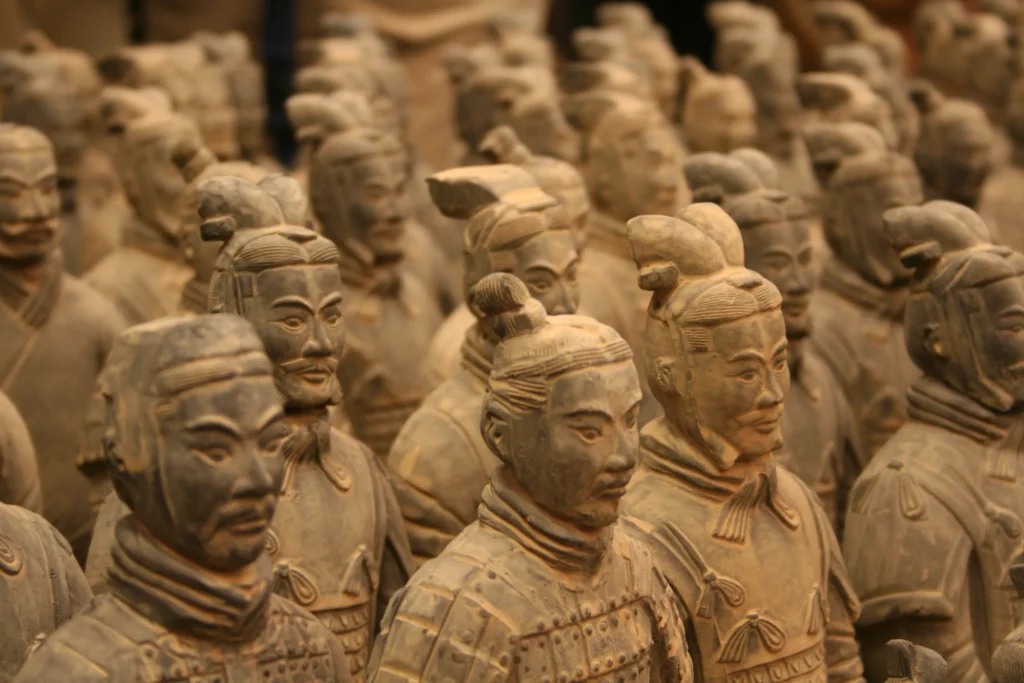
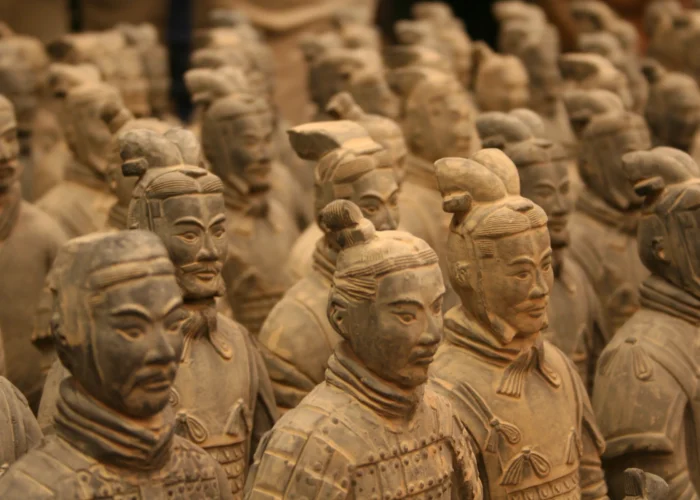
Drive east of the city to the Terracotta Army, part of the burial complex of Qin Shi Huang, the ruler who first unified China in 221 BC. Discovered by farmers digging a well in 1974 and listed by UNESCO in 1987, the pits hold thousands of life-size warriors, each with an individual face, hairstyle and uniform. Your guide walks you through the three main pits and the bronze chariot gallery, explaining how the figures were made and how the work of excavation continues today.
Return to the city for the Ancient City Wall, built in the Ming dynasty and one of the best preserved city walls in China. Walk a section along the broad top, or hire a bicycle and pedal past the gate towers and watchtowers, looking down on old rooftops on one side and the modern city on the other.
Meals: Breakfast. Accommodation: Hotel in Xi’an.
A visit to an imperial Han tomb, then a flight west to the desert oasis of Dunhuang.
Visit the Hanyang Tomb, the mausoleum of Emperor Jing of the Western Han dynasty and his empress. Where the Terracotta Army is all about scale, this site is about detail: thousands of small figures of officials, servants and animals, many still in the pits where they were found. An underground museum lets you walk on glass above the excavations.
Your driver takes you to the airport for the flight to Dunhuang, roughly two and a half hours. From the air, the green of the Wei River valley gives way to the browns and golds of the Gansu desert.
Your Dunhuang guide meets you and takes you to your hotel in Dunhuang. This oasis town was once the last major stop inside China for caravans heading west into the Taklamakan Desert.
Meals: Breakfast. Accommodation: Hotel in Dunhuang.
Buddhist art spanning a thousand years in the morning, golden dunes and a desert spring by evening.
Begin at the Mogao Caves, a UNESCO World Heritage Site cut into a cliff face along a dry riverbed. Over roughly a thousand years, from the 4th to the 14th century, monks, merchants and local rulers paid for hundreds of cave temples to be carved and painted here. A visitor centre film sets the scene, then a specialist guide opens a selection of caves, lit by torch, to reveal Buddhas, flying apsaras and scenes of Silk Road life in remarkable colour.
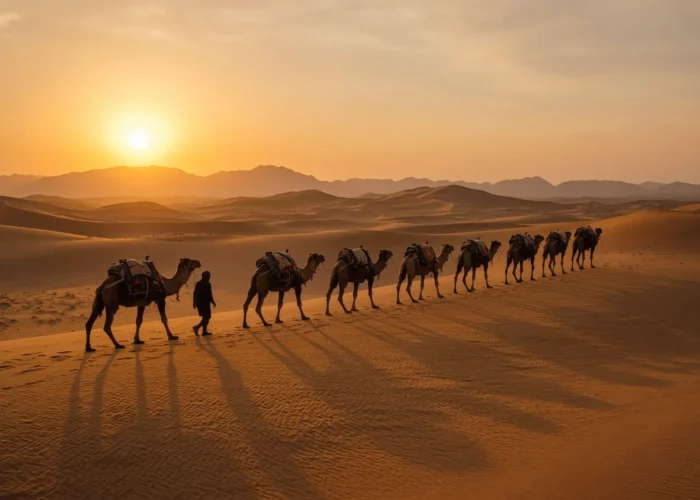
As the heat softens, head to the Singing Sand Dunes on the edge of town, named for the low hum the sand makes when it slides in the wind. Climb a ridge for wide views over the desert, then walk down to Crescent Moon Spring, a small curved pool that has survived among the dunes for centuries, with a pavilion on its bank.
Meals: Breakfast. Accommodation: Hotel in Dunhuang.
Detour to the quieter Yulin Caves, then take the high-speed train into Xinjiang.
Drive out to the Yulin Caves, a smaller sister site to Mogao set in a narrow river gorge. Fewer visitors make it this far, and the murals, especially those from the Tangut-ruled Western Xia period, are among the finest in the Dunhuang region.
Continue by private car to Liuyuan, about two and a half hours in total, and board the high-speed train west to Turpan, roughly three and a half hours. The line runs through stony desert with the Tianshan Mountains rising on the horizon.
Your Turpan guide meets you and takes you to your hotel in Turpan. The town sits in one of the lowest depressions on earth, and its vineyards and raisin-drying houses show how a desert can be turned into a garden with careful use of water.
Meals: Breakfast. Accommodation: Hotel in Turpan.
A full day among the ruined cities, cave temples and mud-brick villages of the Turpan basin.
Explore the Gaochang Ruins, the remains of a walled city that served as a kingdom’s capital and a busy Silk Road stop for centuries. The monk Xuanzang is said to have preached here on his way to India. Walk among the eroded earthen walls and the outline of a great monastery.
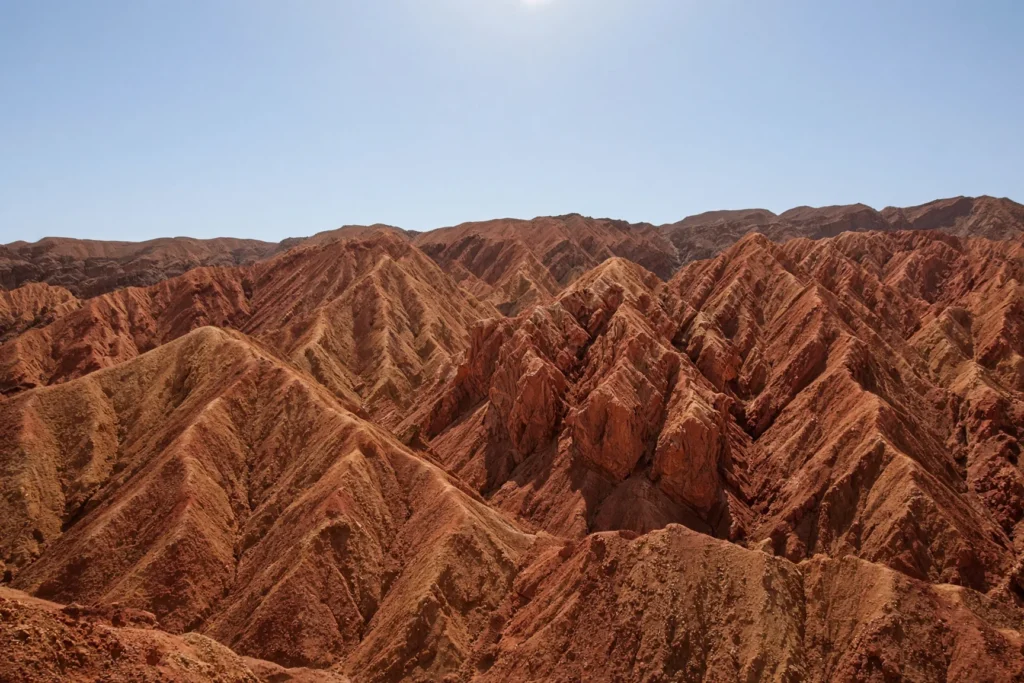
Drive along the foot of the Flaming Mountains, red sandstone ridges that seem to flicker in the heat haze and appear in the classic novel Journey to the West. Tucked into a gorge nearby are the Bezeklik Thousand Buddha Grottoes, Buddhist cave temples whose surviving murals hint at the splendour of the originals.
Finish in Tuyoq, one of the oldest Uyghur villages in the region, with flat-roofed mud-brick houses, grape trellises and narrow lanes climbing toward a green valley. Walk through slowly and take in the rhythm of daily life here.
Meals: Breakfast. Accommodation: Hotel in Turpan.
Turpan’s minaret, a clifftop ruined city and ancient water channels, then a flight to Kashgar.
Start at the Emin Minaret, also called the Sugong Tower, a tapering tower of patterned sun-baked brick built in the 18th century beside a mosque among the vineyards. Then visit a Karez site to see the underground irrigation channels that carry snowmelt from the mountains, the reason Turpan’s fields stay green.
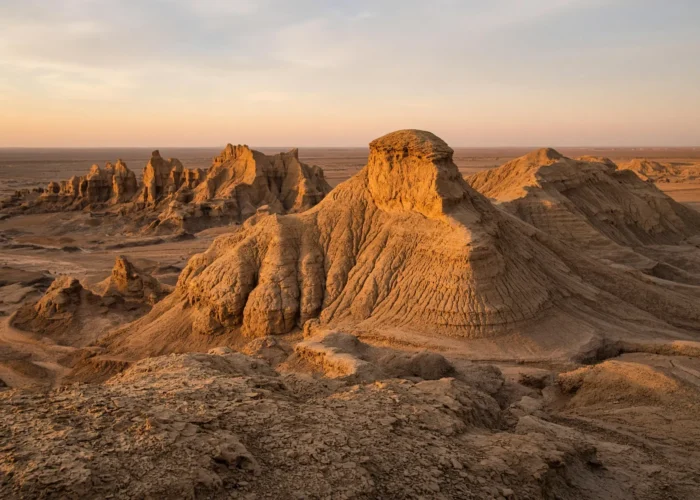
Walk the Jiaohe Ruins, an ancient city built on a narrow plateau between two riverbeds. Much of it was carved down into the earth rather than built up, and the streets, temples and houses still stand in outline. It is part of the UNESCO-listed Silk Roads network.
Drive to Urumqi airport, about two and a half hours, for the flight to Kashgar. Your guide meets you on arrival and takes you to your hotel in Kashgar.
Meals: Breakfast. Accommodation: Hotel in Kashgar.
Kashgar’s great mosque, a tiled family tomb and the bustle of a Silk Road market.
Visit the Id Kah Mosque, the largest mosque in China, its yellow-tiled gatehouse facing a busy square at the centre of Kashgar. Then drive to the Abakh Khoja Tomb, a family mausoleum faced in green and blue tiles, linked in legend to Iparhan, known in Chinese as the Fragrant Concubine.
Spend the afternoon at the Sunday Bazaar, a sprawling market where traders sell carpets, spices, dried fruit, knives, hats and musical instruments. Your guide helps you find the best stalls and makes introductions, so you can try a fresh naan from the clay oven or a cup of sweet tea while you watch the trading.
Good to know: The livestock and Sunday market is busiest on Sundays. We plan your days so the market visit falls as close to Sunday as your dates allow.
Meals: Breakfast. Accommodation: Hotel in Kashgar.
A day of flights from the far west to the capital.
Your guide takes you to the airport for the flight to Urumqi, where you connect onto a flight east to Beijing. It is a long travel day that crosses most of the width of China.
Your Beijing guide meets you at the airport and your driver takes you to your hotel in Beijing. Relax after the journey, or take a short walk to stretch your legs before tomorrow’s sightseeing.
Meals: Breakfast. Accommodation: Hotel in Beijing.
The heart of imperial Beijing, from the palace of the emperors to their lakeside retreat.
Begin at Tiananmen Square, one of the largest public squares in the world, surrounded by monumental buildings. Walk through the Gate of Heavenly Peace into the Forbidden City, home to twenty-four emperors of the Ming and Qing dynasties and a UNESCO World Heritage Site. Your guide leads you through its great halls, courtyards and private quarters, explaining court life and the symbolism behind the yellow roofs and red walls.
Drive to the Summer Palace, the imperial summer retreat, also listed by UNESCO. Stroll the Long Corridor with its thousands of painted scenes, look up at the Tower of Buddhist Incense on Longevity Hill and enjoy the views across Kunming Lake.
The evening is at leisure. If you wish, your guide can arrange tickets for a kung fu performance, an energetic show of Chinese martial arts.
Meals: Breakfast. Accommodation: Hotel in Beijing.
Morning rituals at an imperial temple, then a walk along one of the finest stretches of the Great Wall.
Visit the Temple of Heaven, where Ming and Qing emperors prayed for good harvests. Its round, triple-roofed Hall of Prayer for Good Harvests is one of the best-known buildings in China. The surrounding park is full of local residents doing tai chi, dancing, singing and playing cards, a lovely slice of Beijing life.
Drive north to the Mutianyu Great Wall, a restored Ming dynasty section set on forested ridges. Ride the cable car up to the wall, then walk between watchtowers at your own pace, with the wall rolling away over the hills in both directions.
Return to the city in the afternoon and enjoy your last evening in Beijing at leisure.
Meals: Breakfast. Accommodation: Hotel in Beijing.
Farewell to China after a journey from the bamboo groves of Sichuan to the Great Wall.
Enjoy a final breakfast at your hotel. At the agreed time, your driver and guide take you to the airport for your onward flight.
Meals: Breakfast.
Accommodation in your chosen hotel class, with daily breakfast
Meals as listed in the itinerary
Private air-conditioned vehicle with driver for all transfers and touring
Private English-speaking local guide in each destination
Domestic flights, high-speed trains and river cruises as listed in the itinerary
All entrance fees, performances, boat trips and excursions as listed
Bottled water during touring
International flights
China visa fees, where a visa is needed for your nationality
Travel insurance
Tips for guides and drivers
Drinks and personal expenses
Meals not listed in the itinerary
Indulge in a vivid, sensory panorama of our cherished destinations, carefully curated to ignite your wanderlust and craft a tantalizing prelude to your forthcoming journey!
Free quote, no obligation
Are you looking for an unforgettable experience in Southeast Asia? Look no further! Our company offers tours that will take you on a journey through the beautiful landscapes and rich cultures of this region. Join us for an adventure of a lifetime!
“The journey with Orient Charm and the Team was impeccably organized from dawn till dusk, turned our adventure into a breezy, carefree escapade.”
“...everything showcased online was even better in reality. Outstanding service, delectable food, splendid hotel rooms, and the highlight was the personnel.”
“Our travel maestro, Khunie, delivered a performance par excellence, presenting us with an exquisite welcome gift right on day one in the bustling metropolis of Hanoi.”
Tailor-made
Tailor-made
Tailor-made
Tailor-made
Tailor-made
Tailor-made
Tailor-made
Tailor-madeThree quick questions and we will match you with the right journeys.