When Traveling Is Caring ❤️

မန္တလေးCentral Myanmar21.98° N · 96.08° E
The last royal capital of Myanmar, and the gateway to three older capitals within an hour's drive. Here is what to see, what to eat and how to plan your days.
King Mindon founded Mandalay in 1857 as a new royal capital at the foot of Mandalay Hill, and it was the seat of the last Burmese kings until the British took the city in 1885. The moated palace walls still form a huge square in the middle of town, and the city remains the cultural heart of upper Myanmar, home to many monasteries, Buddhist scholars and traditional crafts.
Mandalay itself is a busy, dusty, grid-planned city, and honestly not the most charming place to wander. Its real treasures are specific: the Mahamuni Pagoda and its gold-covered Buddha, the teak carvings of Shwenandaw Monastery, the marble slabs of Kuthodaw, workshops beating gold leaf by hand and the sunset view from Mandalay Hill.
Just beyond the city lie three earlier royal capitals, Amarapura, Inwa and Sagaing, plus the unfinished giant pagoda at Mingun up the river. Most travellers spend two or three nights here, often between Bagan and Inle Lake. This guide covers the sights, the food and how to plan a day among the old capitals.
Every journey below is private and tailor-made, with a guide who can take you beyond the city to the old capitals at your own pace.
We tailor every trip. Want more time in Mandalay, a different pace or a mix of places? Design my trip →
How our local guides would spend one full day in the city, starting before dawn and finishing on the old teak bridge.
Watch the senior monk wash the face of the revered Mahamuni Buddha in a calm pre-dawn ritual.
Mont di noodles or a bowl of Shan noodles with sweet milky tea.
A carved teak monastery that once stood inside the royal palace, covered in fine woodwork.
Hundreds of small white shrines, each holding a marble slab carved with Buddhist scripture.
See how gold is beaten by hand into the thin leaves pilgrims press onto Buddha images.
A Myanmar curry spread, then an hour out of the midday heat.
The old capital south of the city, with silk weaving workshops and quiet lanes by the lake.
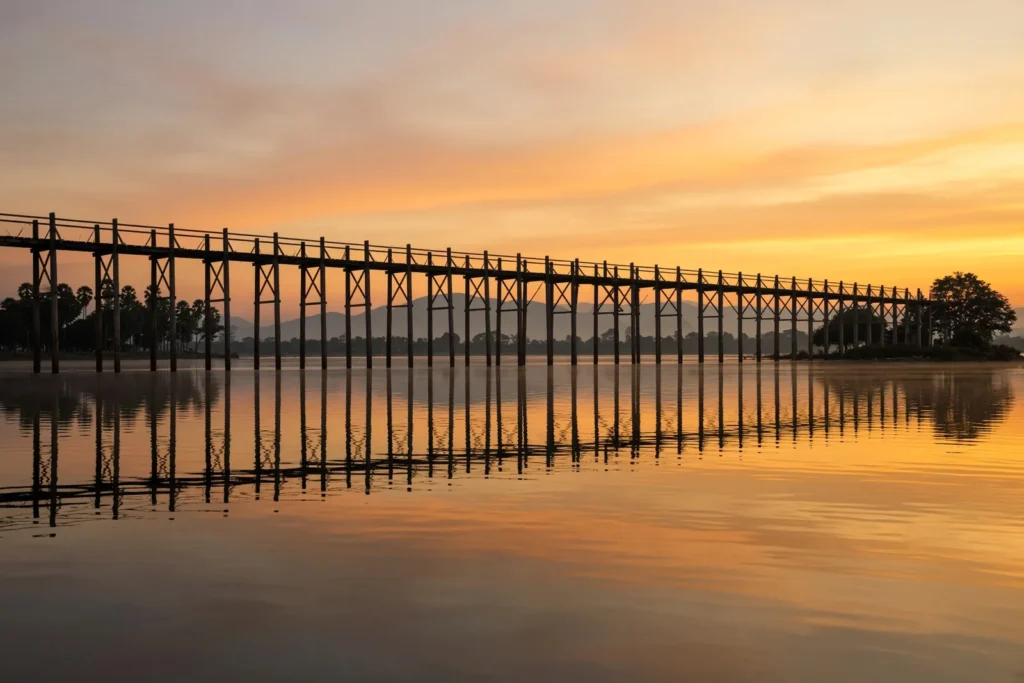
Walk the long teak bridge, or watch from a small boat as the sun drops behind it.
Before Mandalay, the Burmese court moved between several nearby capitals, and their remains are the most rewarding part of a stay here. This is how we would see them.
The capital before Mandalay, south of the city. Its highlight is U Bein Bridge, a long teak footbridge across Taungthaman Lake, along with silk weaving workshops.
Also known as Ava, a royal capital for centuries. Today it is a quiet rural island of fields and ruins, explored by horse cart after a short river crossing.
A brief capital in its own right, and now a spiritual centre. Its hills are covered with white and gold pagodas and hundreds of monasteries and nunneries.
Not a capital, but a classic half-day trip up the Ayeyarwady by boat. See the giant unfinished pagoda cracked by an earthquake in 1839, a huge bronze bell and the white Hsinbyume Pagoda.
The experiences our travellers enjoy most, in order of what we would not miss.
Home of the most revered Buddha image in upper Myanmar, thickly coated in gold leaf by pilgrims. Come before dawn for the daily face-washing ritual.
Covered stairways lead up past shrines to a hilltop pagoda with views over the city, the palace and the river. You can also drive most of the way.
A teak monastery richly carved with mythical figures, once part of the royal palace and moved outside its walls, which saved it from later destruction.
Rows of small white shrines each house a marble slab inscribed with Buddhist scripture, often called the world's largest book.
The moat and walls are original and impressive, though the palace buildings inside are largely reconstructions and only part of the compound is open.
A long teak footbridge over a shallow lake, busy with locals at dawn and dusk. Watching from a small boat at sunset is the classic view.
A peaceful old capital of fields, teak and brick monasteries and a leaning watchtower, reached by a short river crossing.
Pagoda-dotted hills across the river, with monasteries, nunneries and wide views over the Ayeyarwady.
A slow river trip to a vast unfinished pagoda, a giant bronze bell and the white tiered Hsinbyume Pagoda.
Watch young men beat gold for hours into wafer-thin leaves, then see them cut and packed by hand.
Streets near the Mahamuni Pagoda are full of workshops shaping marble Buddha images and carving teak.
Traditional Myanmar marionettes still perform in the city, a delicate art with music, dance and old stories.
Plan your private, tailor-made Myanmar trip for 2027 now and get $100 off. Tell us your travel dream and we will design it with you.
Customise My TripLocal specialities worth seeking out, and when the locals eat them. Your guide will know the best places to try each one.
Add a food experience →Mandalay International Airport lies well south of the city, with domestic flights from Yangon, Bagan and Heho for Inle Lake, and some regional flights. Bagan is also about 4 to 5 hours away by road, and in some seasons by boat on the Ayeyarwady.
Included on our journeys, essential for the spread-out sights and the old capitals.
Best for: SightseeingFor Mingun and the slow trip to Bagan in season.
Best for: MingunApps such as Grab offer cars in the city for short trips.
Best for: Short hopsPlaces that pair well with Mandalay, with approximate travel times.
November to February is the most comfortable time, dry and pleasant with cool mornings. March to May is very hot, often uncomfortably so in the middle of the day. Mandalay is in the dry zone, so the June to October monsoon brings less rain than the south, but it is humid and some days are wet.
A general guide. Weather varies from year to year, and we plan each route around the season.
Quick answers from our local team. Anything else, just ask your travel specialist.
Ask us on WhatsAppYes, though mostly for what surrounds it. The city itself is busy and dusty, but its pagodas, monasteries and crafts are excellent, and the old capitals of Amarapura, Inwa and Sagaing are among the most rewarding places in Myanmar.
Two full days work well: one for the city sights and one for the old capitals. Add a third for Mingun by boat or a trip to the hill town of Pyin Oo Lwin.
Sunset is the classic time, ideally watched from a small boat on the lake. It is busy, so arrive early. Dawn is quieter, with locals crossing on foot and soft light on the water.
Only men may approach the main image to press gold leaf onto it. Women are welcome to watch and pray from the area in front of the shrine, where the image is clearly visible.
It has become very crowded with visitors, which many people find uncomfortable. If you go, stay back, stay quiet and do not push for photos. We often suggest a quieter monastery instead.
By road in about 4 to 5 hours in a private car, by air in around 30 minutes, or in some seasons by boat down the Ayeyarwady, which takes most of a day.
Travel advice for Myanmar changes often, and many governments advise against travel to some or all of the country. Check your government's latest advice and your travel insurance before planning. We only suggest routes our local team considers safe at the time, and we will tell you plainly if a place is not a good idea right now.
Cover shoulders and knees, and take off shoes and socks at every pagoda and monastery, including on the stairways of Mandalay Hill. Slip-on sandals and a light scarf are useful.
Tell us what you have in mind and a local travel specialist will design a private itinerary around you. Free, with no obligation.
Three quick questions and we will match you with the right journeys.