When Traveling Is Caring ❤️

Điện Biên PhủNorth-West Vietnam21.39° N · 103.02° E
The remote valley where the 1954 battle ended French rule in Indochina. Here is what to see on the battlefield, how to get here and how it fits a north-west loop.
Dien Bien Phu sits in a broad, rice-filled valley in Vietnam's far north-west, close to the border with Laos. In 1954 it was the scene of the decisive battle of the First Indochina War: from March to May, Viet Minh forces under General Vo Nguyen Giap besieged the French garrison, which surrendered on 7 May 1954. The defeat led directly to the Geneva Accords and the end of French rule in Indochina.
Today the town is a quiet provincial capital, and the battlefield is spread across the hills around it. You can walk the trenches of Hill A1, see the reconstructed command bunker of the French commander, visit a large modern museum and climb to the Victory Monument. It is a place for history lovers, and it is a long way from anywhere, so most visitors include it on a loop through the north-west mountains.
Our private, tailor-made journeys can include Dien Bien Phu on a north-west loop, with a local guide who brings the battlefield to life.
We tailor every trip. Want more time in Dien Bien Phu, a different pace or a mix of places? Design my trip →
The experiences our travellers enjoy most, in order of what we would not miss.
A large modern museum telling the story of the 1954 battle, with maps, photographs and weapons. Start here to understand the battlefield.
The most fiercely fought position of the battle, with preserved trenches, a bunker, an old tank and a large mine crater on the hilltop.
The reconstructed command bunker of the French commander, where the garrison's surrender was taken on 7 May 1954.
A large bronze monument on a hill above the town, with wide views across the valley that help you picture the scale of the siege.
General Giap's forest command post in the hills outside town, a peaceful spot among trees with bunkers and huts reconstructed.
One of the north-west's great mountain passes, on the road from Son La, with sweeping views and a famous wartime supply route.
Plan your private, tailor-made Vietnam trip for 2027 now and get $100 off. Tell us your travel dream and we will design it with you.
Customise My TripDien Bien Airport has flights from Hanoi, which saves a very long drive. By road, most travellers arrive on a north-west loop via Son La or from Sapa and Lai Chau. The Tay Trang border crossing into Laos is nearby, useful for overland journeys towards Muang Khua.
Places that pair well with Dien Bien Phu, with approximate travel times.
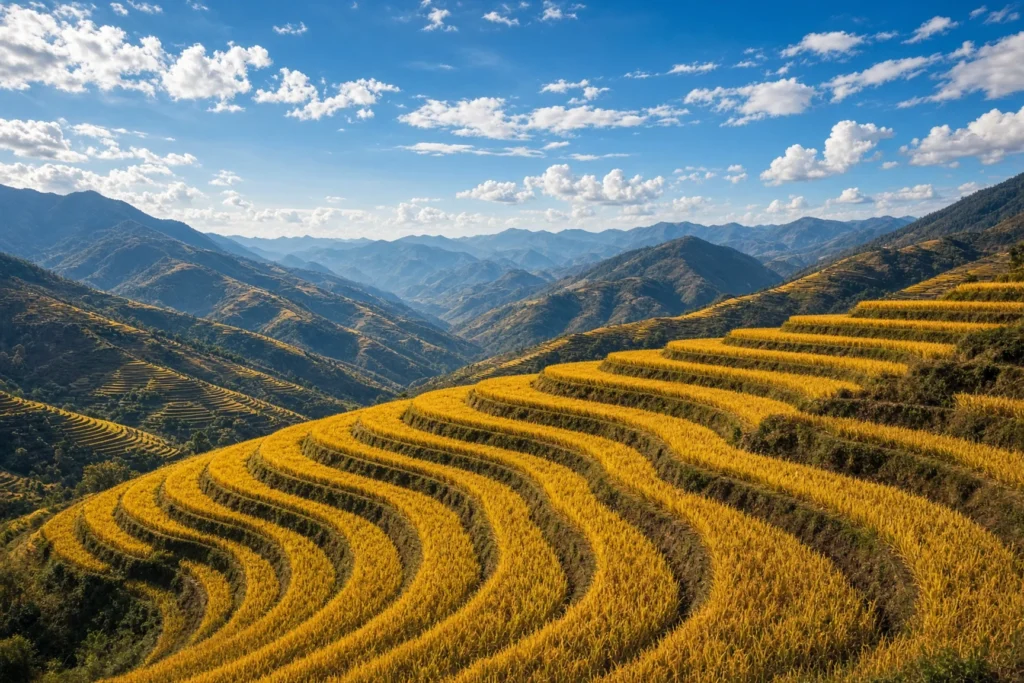
October to April is the driest and clearest time, with comfortable days, though December and January nights are cold. Golden rice fills the valley around September and October. Summer is hot with heavy rain, and landslides can affect mountain roads.
A general guide. Weather varies from year to year, and we plan each route around the season.
Quick answers from our local team. Anything else, just ask your travel specialist.
Ask us on WhatsAppFor anyone interested in history, yes: it is where the First Indochina War was decided in 1954. If the war history does not interest you, the long journey is hard to justify on its own, though the north-west scenery helps.
Fly from Hanoi in about an hour, or drive as part of a north-west loop through Son La or Lai Chau. We often suggest flying one way and driving the other.
One full day covers the museum, Hill A1, the De Castries Bunker and the Victory Monument. Add a second day for Muong Phang or a slower drive onwards.
Tell us what you have in mind and a local travel specialist will design a private itinerary around you. Free, with no obligation.
Three quick questions and we will match you with the right journeys.