When Traveling Is Caring ❤️

ປາກເຊSouthern Laos15.12° N · 105.80° E
A practical river town and the gateway to Laos' quiet south: coffee and waterfalls on the Bolaven Plateau, the temple ruins of Wat Phou and the islands of Si Phan Don. Here is how to plan it.
Pakse sits where the Xe Don river meets the Mekong, the largest town in southern Laos and the starting point for almost every trip in the region. The town itself is pleasant but not a destination: a market, a few temples, a big hilltop Buddha across the river and plenty of practical hotels. Its value is in what lies within a few hours.
To the east rises the cool Bolaven Plateau, with coffee farms and some of the most impressive waterfalls in Laos. To the south lies Champasak and Wat Phou, a Khmer temple complex climbing a mountainside, with origins older than Angkor, listed by UNESCO in 2001. Further south, the Mekong spreads out into Si Phan Don, the 4,000 Islands, where life slows to a crawl in hammocks and on bicycles beside the river.
We usually suggest one night in Pakse, then time on the plateau, in Champasak and on the islands, before continuing to Cambodia or flying back north.
Every journey below is private and tailor-made, so we can shape the south around waterfalls, temples, island time or an onward route to Cambodia.
We tailor every trip. Want more time in Pakse, a different pace or a mix of places? Design my trip →
Southern Laos rewards a loop rather than a rush. This is how our local team usually plans it, with Pakse as the hinge.
A cooler upland of coffee farms and big waterfalls, about an hour or more east of Pakse. Do it as a long day trip, or stay a night near the falls.
A sleepy riverside village about an hour south of Pakse, close to the UNESCO-listed temple. Stay a night so you can reach the ruins early, before the heat.
About 2.5 to 3 hours south of Pakse. Don Khon and Don Det are the most visited; Don Khong is larger and quieter. Cycle, swim in the dry season and watch the river.
The islands are close to the Cambodian border, so the south flows naturally into Stung Treng, Kratie and Siem Reap. Check current visa rules before you travel.
The experiences our travellers enjoy most, in order of what we would not miss.
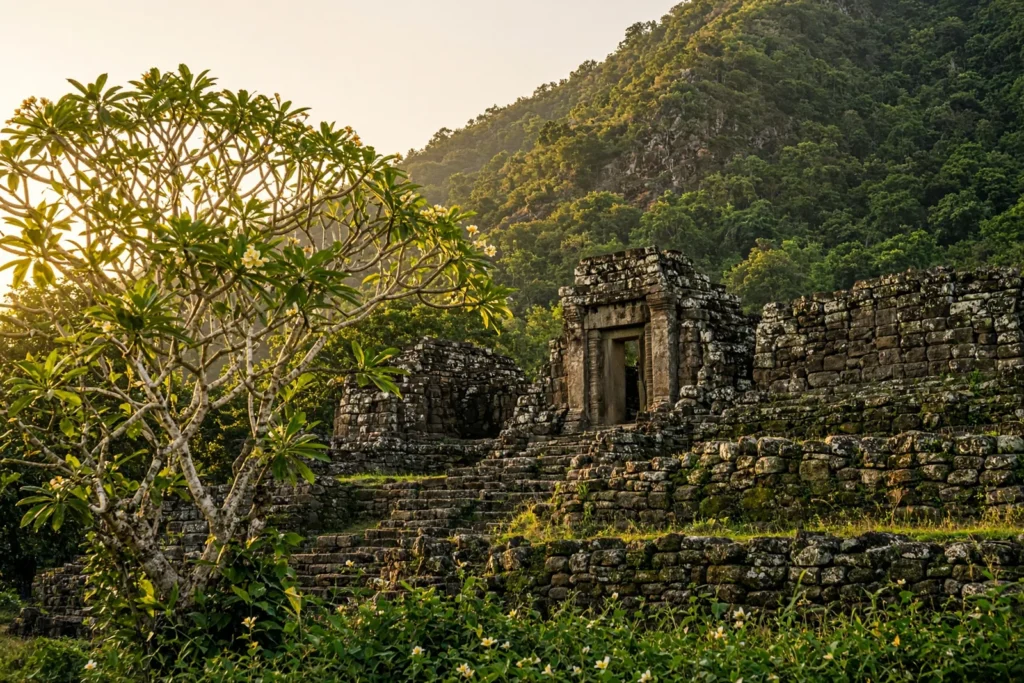
A Khmer temple complex climbing the slope of a sacred mountain near Champasak, with origins that predate Angkor Wat, listed by UNESCO in 2001. Go early for cool air and soft light.
Tad Fane, Tad Yuang and Tad Lo are among the best-known falls, plunging off the plateau into the forest. Most powerful from late in the rainy season.
The plateau grows most of Laos' coffee. Visit a small farm to see how it is grown and processed, and taste it fresh.
Cycle between the islands of Don Det and Don Khon, past paddies and old French railway relics, with the Mekong on every side.
Among the largest waterfalls in Southeast Asia by volume, a wide, roaring stretch of rapids that blocks river navigation to Cambodia.
A quiet riverside village of old wooden houses and colonial villas, the best base for an early start at Wat Phou.
Walk the riverside and morning market, then cross the river to the large golden Buddha on the hill for views over both rivers.
Plan your private, tailor-made Laos trip for 2027 now and get $100 off. Tell us your travel dream and we will design it with you.
Customise My TripPakse has domestic flights from Vientiane and some regional flights. Many travellers come overland from Ubon Ratchathani in Thailand via the Chong Mek border, about an hour from Pakse, or from Cambodia via Stung Treng to the 4,000 Islands.
The only practical way to link plateau, temple and islands at your own pace.
Best for: Touring the southShort crossings and trips between the islands of Si Phan Don.
Best for: 4,000 IslandsIdeal on the flat islands and in Champasak village.
Best for: IslandsPlaces that pair well with Pakse, with approximate travel times.
November to February is the most comfortable time, dry and sunny. March to May is very hot in the south, especially on the islands. The rainy season, roughly May to October, makes the Bolaven waterfalls most impressive, but some roads and river activities are harder going.
A general guide. Weather varies from year to year, and we plan each route around the season.
Quick answers from our local team. Anything else, just ask your travel specialist.
Ask us on WhatsAppAt least four nights: one around Pakse or the Bolaven Plateau, one in Champasak for Wat Phou, and two on the 4,000 Islands. Six nights allows a slower pace and an overnight on the plateau.
The town itself is a pleasant one-night stop rather than a destination. Its real value is as the gateway to Wat Phou, the Bolaven Plateau and Si Phan Don, which together are some of the most relaxing travel in Laos.
Very unlikely. The small population in the pool on the Cambodian border has all but disappeared. Enjoy the islands for the river, waterfalls and village life rather than a dolphin sighting.
By road to the Mekong landing near Nakasang, about 2.5 to 3 hours, then a short boat crossing to Don Det or Don Khon. Don Khong is reached by a bridge. Your travel consultant will arrange the transfer and boat.
Yes. The border south of Si Phan Don connects with Stung Treng, and from there Kratie and Siem Reap. Visa rules change, so check the latest information for your passport before travelling.
Tell us what you have in mind and a local travel specialist will design a private itinerary around you. Free, with no obligation.
Three quick questions and we will match you with the right journeys.