When Traveling Is Caring ❤️

黄山Eastern China30.13° N · 118.17° E
Granite peaks above a sea of cloud, and two of China's loveliest old villages at their feet. Here is how to plan the mountain, Hongcun and Xidi, and what to expect.
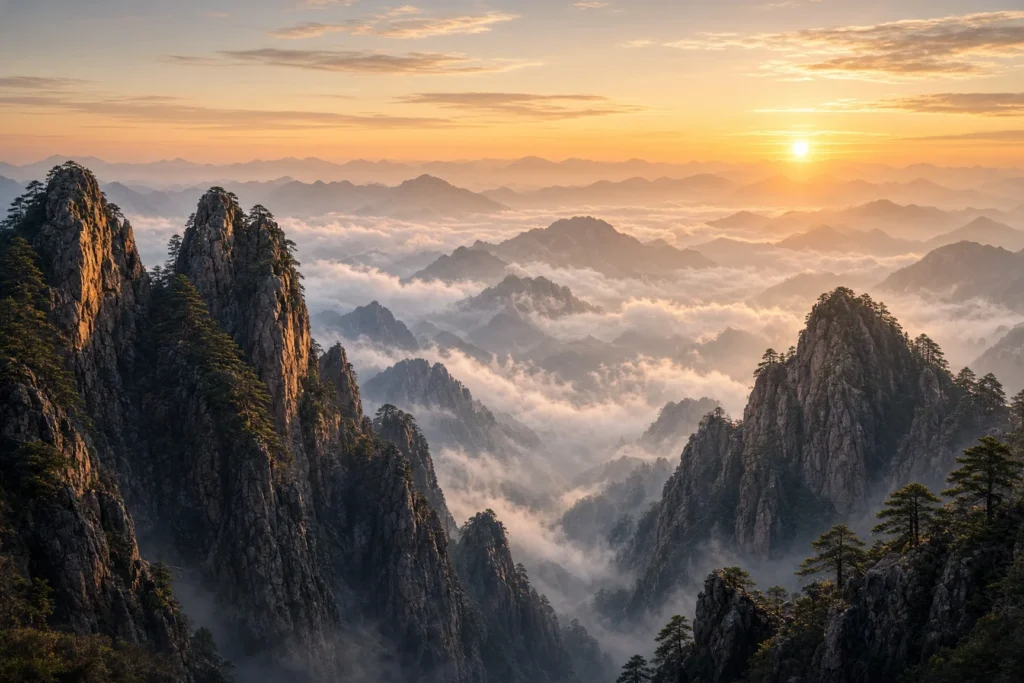
Huangshan, the Yellow Mountain, is a range of granite peaks in southern Anhui that has inspired Chinese painters and poets for centuries. Twisted pines grow straight out of the rock, stone stairways climb between pinnacles, and on good days the valleys fill with a sea of cloud. It was inscribed by UNESCO in 1990 for both its scenery and its cultural importance, and its highest point, Lotus Peak, rises to 1,864 metres.
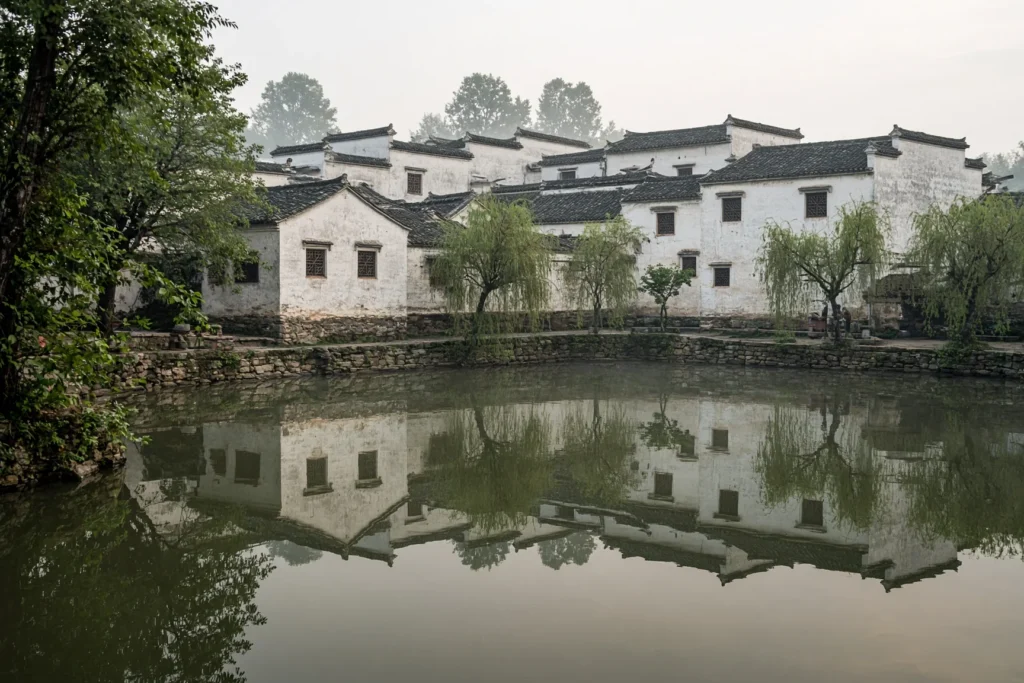
At the foot of the mountain lies old Huizhou, a region of merchant villages with white walls, stepped horse-head gables and carved wooden halls. Hongcun and Xidi, inscribed by UNESCO in 2000, are the best preserved. Hongcun is laid out around a crescent pond and canals, and its reflections are some of the most photographed scenes in China. Together, mountain and villages make one of the most rewarding short trips in eastern China.
Our Huangshan journeys are private and tailor-made, usually combining a night on the mountain with Hongcun and Xidi, and linking easily with Hangzhou or Shanghai.
We tailor every trip. Want more time in Huangshan, a different pace or a mix of places? Design my trip →
This is the decision that shapes a Huangshan trip. Here is how we usually advise.
Ride up by cable car, walk the western loop and Xihai Grand Canyon, sleep near the summit and catch sunrise before walking down.
Up and down by cable car in one day, focusing on the eastern summit area and Beginning-to-Believe Peak.
Allow at least half a day for the two villages, ideally staying nearby for the quiet morning light.
The experiences our travellers enjoy most, in order of what we would not miss.
Stay on the mountain and walk to a viewpoint such as Lion Peak or Bright Summit before dawn. On clear mornings the sun rises over a sea of cloud.
A dramatic loop of stairways and walkways cut into deep granite gorges, with a small monorail for part of the route. Strenuous but one of the most spectacular walks in China.
The famous pine reaching from the rock near Jade Screen Peak, a symbol of Chinese hospitality. Busy at midday, calmer early or late. The pine is thought to be several centuries old.
A short walk from the eastern cable car with views over a crowd of jagged pinnacles. Its name comes from the idea that you have to see Huangshan to believe it.
A Huizhou village of white walls and black roofs around the Moon Pond and South Lake. Inside, carved ancestral halls show the wealth of its merchant families.
A short drive from Hongcun, with a memorial archway, narrow lanes and finely carved doors and windows. Usually a little quieter than its neighbour. Allow an hour or two to wander.
A long street of Ming and Qing style shopfronts in Huangshan city, good for an evening stroll and for local ink sticks, inkstones and tea.
Plan your private, tailor-made China trip for 2027 now and get $100 off. Tell us your travel dream and we will design it with you.
Customise My TripLocal specialities worth seeking out, and when the locals eat them. Your guide will know the best places to try each one.
Add a food experience →High-speed trains reach Huangshan North from Hangzhou in about 1.5 hours and from Shanghai in around 3 to 4 hours. Tangkou, the town at the foot of the southern cable cars, is about an hour away by road. Hongcun and Xidi are about an hour from Tangkou.
Links the station, the mountain, the villages and Tunxi, which are all spread out; included on our journeys.
Best for: Getting aroundWalking on stone steps is the only way to explore the summit area between cable car stations.
Best for: The summitPlaces that pair well with Huangshan, with approximate travel times.
April to May and September to November are the best months, with milder temperatures and a good chance of clear views. Autumn colour on the mountain and in the villages is lovely in late October and November. Summer brings heat in the valleys and frequent rain and mist on the peaks. Winter can be icy and some paths close, but snow on the pines is beautiful.
A general guide. Weather varies from year to year, and we plan each route around the season.
Quick answers from our local team. Anything else, just ask your travel specialist.
Ask us on WhatsAppYes, if you can. A night near the summit lets you see sunset and sunrise, the times when the sea of clouds is most likely and the paths are quiet. Hotels on the mountain are simple and luggage is best left below, so pack a small overnight bag.
With cable cars up and down, the summit area still involves several hours of walking on steep stone steps. Climbing the whole way on foot takes many hours each way. A reasonable level of fitness is needed, and walking poles help on the descent.
Three nights works well: one night near the station or villages, one night on the mountain and one in Hongcun or Tunxi. Two nights is possible if you skip the villages or do the mountain as a long day. Add a spare day in case of poor weather on the peaks.
Both are worth seeing, and they are only a short drive apart. Hongcun is more famous for its ponds and reflections, so it is busier. Xidi is often calmer and has fine carved doorways and an old memorial archway. Most travellers visit both in one day.
The summit is cooler than the valleys and changes quickly. Mist and rain are common in any season, so bring a light waterproof and warm layers, even in summer. Paths can be icy in winter, and heavy storms can close cable cars.
Tell us what you have in mind and a local travel specialist will design a private itinerary around you. Free, with no obligation.
Three quick questions and we will match you with the right journeys.